
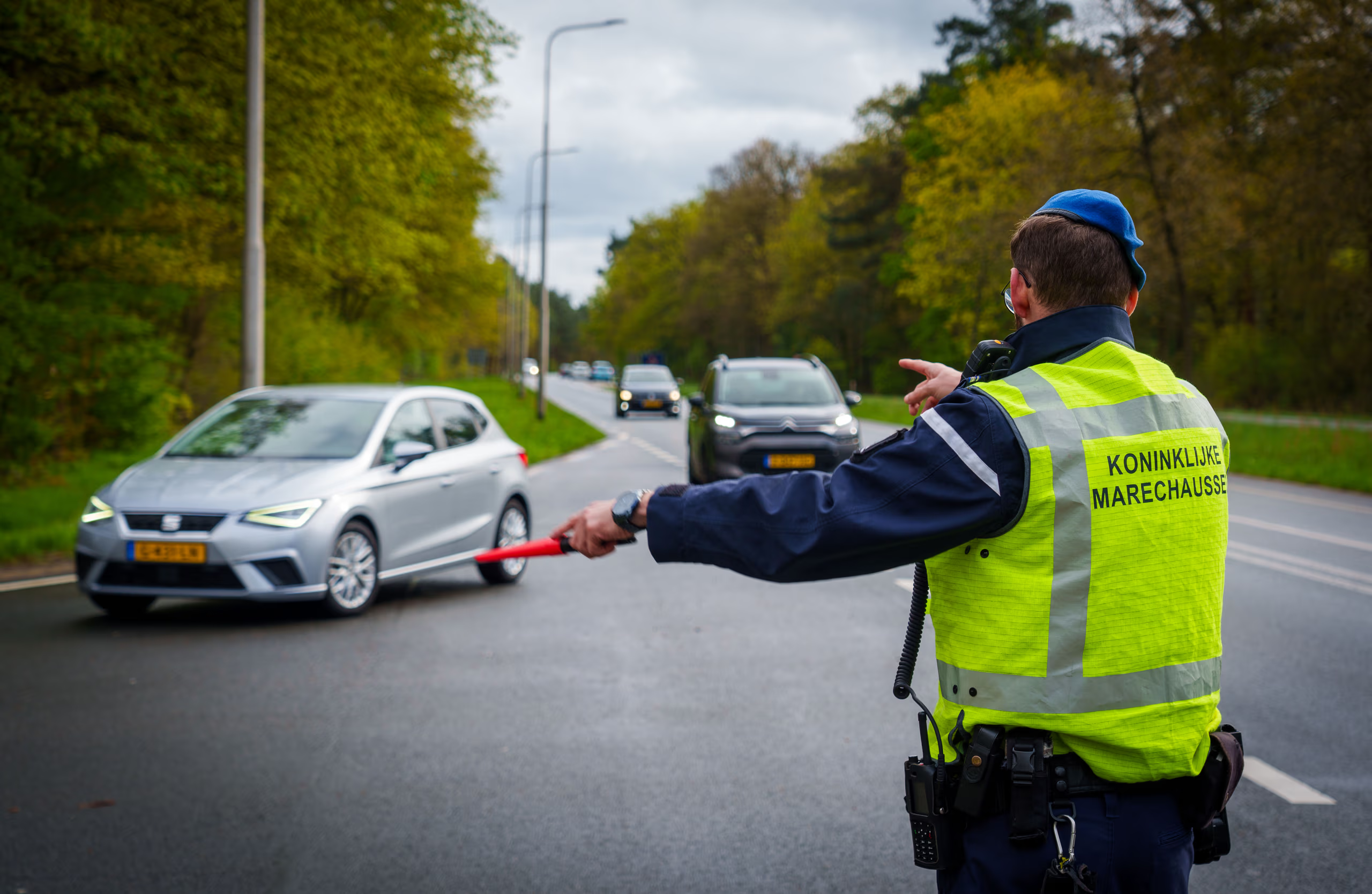
The Netherlands has implemented temporary border controls at its internal borders with other Schengen countries. These controls, carried out by the Royal Netherlands Marechaussee, commenced on 9 December 2024, at the direction of the Ministry of Asylum and Migration to combat irregular migration and cross-border crime. Initially introduced for a six-month period, these temporary border controls have now been extended and will remain in place until 8 June 2026.
Q&A
This government measure aims to combat irregular migration to the Netherlands and tackle human smuggling.
The temporary border controls are based on European agreements. These are described in Article 25 of Regulation (EU) 2016/399, the Schengen Borders Code. This code states that countries may temporarily introduce border controls. This is allowed only if it is necessary for public order or national security.
The border controls are temporary. They commenced on 9 December 2024, were initially in place for six months, and have now been extended. They are currently scheduled to remain in effect until 8 June 2026.
The Royal Netherlands Marechaussee is carrying out checks at the border with Belgium and Germany. These checks may occur at any border crossing point. We are also conducting checks on international trains arriving from the Schengen Area. At airports, we are only checking specific flights with a higher risk of irregular migration or cross-border crime. The Marechaussee carries out these checks based on risk analysis and intelligence. This means that the border controls are not systematic. The frequency and intensity of these checks depend on the situation. We do our utmost to minimise any disruption to cross-border traffic.
Border checks can be carried out in different ways. We can conduct checks on the road, on trains and at airports.
On the road
- Static checks: For large-scale checks, we sometimes close off a section of the motorway and direct traffic to a special checkpoint. There, we check some of the vehicles. To ensure the safety of our staff, it may be necessary to temporarily impose a speed limit. We realise this may cause inconvenience for traffic and do our best to minimise any disruption.
- Mobile checks: We may also carry out smaller, mobile checks. Marechaussee motorcyclists then select vehicles at the border and escort them to a checkpoint.
At airports
At airports, we may check the travel documents of passengers at the arrival gate. This only applies to flights within the Schengen Area. Flights from outside the Schengen Area already go through passport control. We only check specific flights with a higher risk of irregular migration or cross-border crime.
On trains
On international trains arriving from the Schengen Area, Marechaussee officers may check the travel documents of passengers. They walk through the train carriages for this purpose.
Before December 9, 2024, we worked with Mobile Security Monitoring (MTV). With MTV, we sometimes did checks, for example on roads and trains. Under European rules, we were not allowed to do too many of these MTV checks. The temporary border controls we have had since 9 December 2024, replace the MTV for as long as these controls are in place. Different European rules apply to these new controls. That is why we can now check more often and also more people.
The Netherlands has implemented temporary border controls at its internal borders since 9 December 2024. This means that there may be checks when you cross the border. You should therefore always carry a valid travel document (passport or identity card). The Royal Netherlands Marechaussee is carrying out these controls. We do our utmost to minimise any disruption for economic traffic and people who live and work in the border regions.
Asylum seekers can apply for asylum in the Netherlands during these border checks. If they do, they are escorted to a reception centre where their application is processed. If they have previously applied for asylum in another EU country, steps are taken to transfer them to that country under the Dublin Regulation.
The Netherlands has a large number of border crossings, totalling over 840. These include not only motorways and provincial roads, but also various smaller roads. Before the introduction of the Schengen Agreement, which enabled the free movement of people within a large part of Europe, the Netherlands had border checkpoints with permanent controls. In addition, there were also numerous border crossings that were not permanently guarded.
This page was last updated on 11 November 2025.
